Identification is the first job on every call we take, because the four insects people ring about need four different responses. One gets treated, one gets a price and usually a reprieve, one gets a beekeeper's phone number, and one gets reported to a government agency. Work through the three questions below before booking anything.
Question 1: is it hairy?
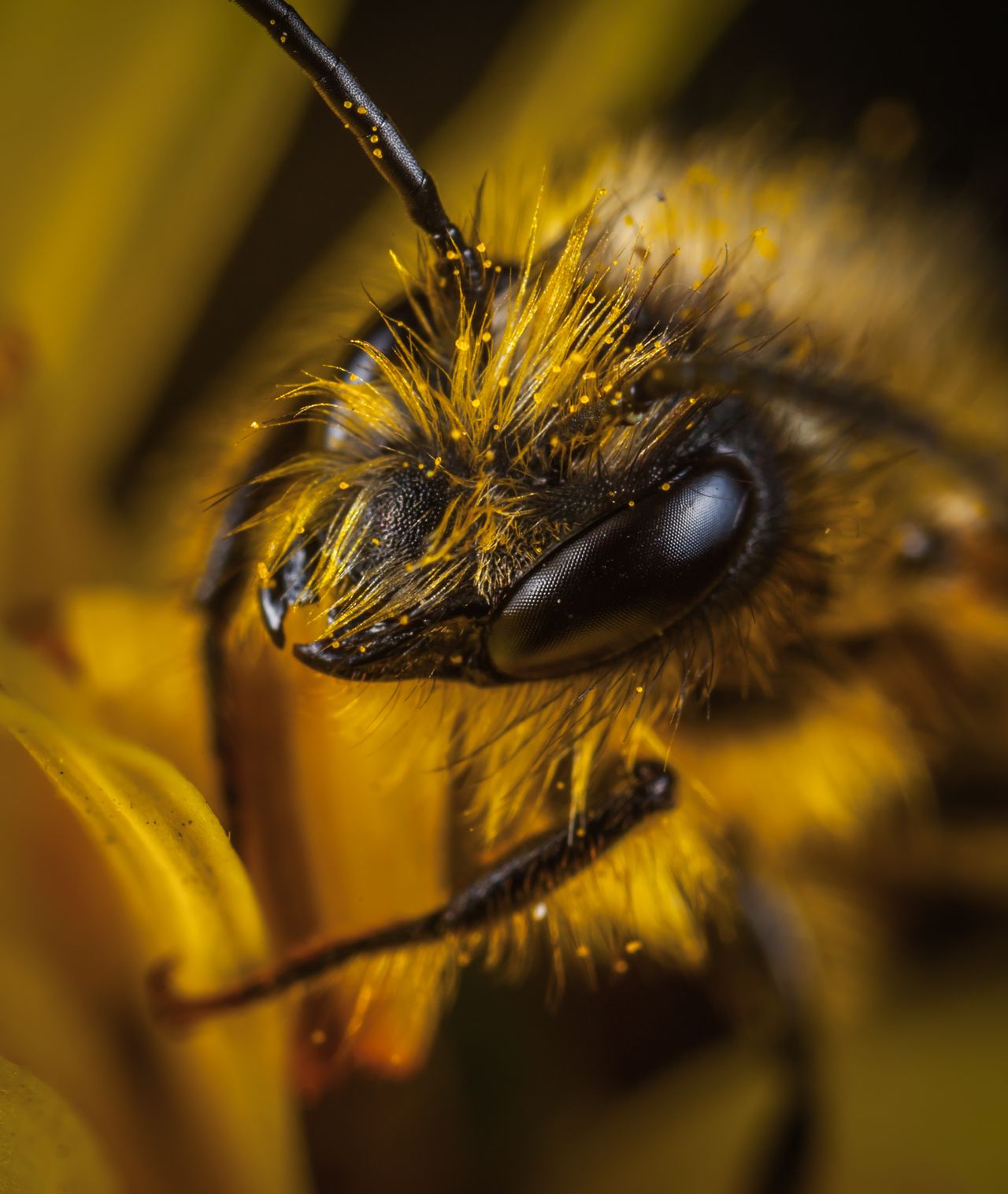
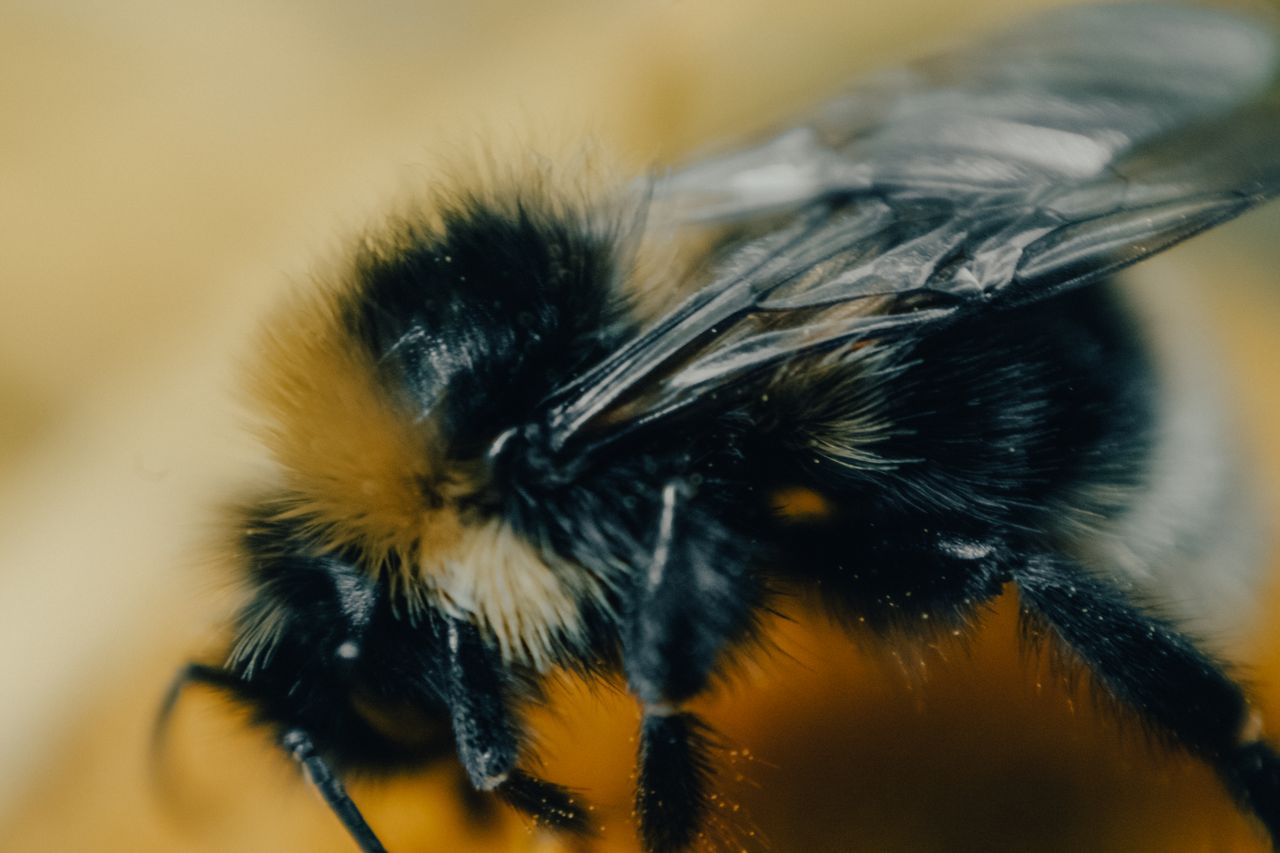
Run your eye over the body, at a sensible distance. Bees are pollen collectors, and the equipment shows: both honeybees and bumblebees have an obviously furred body, dense and teddy-bear-like on a bumblebee, shorter and sleeker on a honeybee. Wasps and hornets carry no meaningful hair at all. Their bodies look lacquered, with crisp edges between the coloured bands.
Question 2: how is it built?
Shape separates the smooth pair from the furry pair even in silhouette. A wasp narrows to a dramatic pinch between thorax and abdomen and hangs its legs in flight; its movements are darting and abrupt. A bumblebee is a rounded barrel that drones slowly from flower to flower. A honeybee sits between the two, slender but soft-edged, flying in businesslike straight lines. Hornets read as wasps scaled up, with more brown and chestnut in the colouring than the common wasp's vivid yellow.
Question 3: how big is it?
Size settles the last doubt. Common and German wasps sit around the length of a one-pound coin's diameter. Honeybees match them roughly. Bumblebee queens can be twice that bulk, though still unmistakably furry. A European hornet dwarfs them all at up to 3.5 cm, with a flight noise you feel as much as hear. Genuine hornet sightings this far north are uncommon; most "hornets" reported to us are queen wasps seen in spring, when they look startlingly large.
What each identification means for you
It's a wasp
A steady stream of these entering one gap in a roof, wall, shed or lawn is an active colony, and it will grow until autumn whatever you do. This is the standard job: treated through the entrance for a fixed £60 anywhere in Stockport and Greater Manchester, with the colony finished within hours. The nest itself, a grey papery ball of chewed wood fibre, never gets reused, so removal of the empty structure is optional.
It's a bumblebee
Round, furry and unhurried, often nesting in an old mouse hole, a bird box, under decking or in a compost heap. Our honest advice on most bumblebee calls is to do nothing, because the colony is small, placid and finished by autumn. Where one genuinely cannot stay, treatment is £70. The tree bumblebee, a recent arrival that favours lofts and bird boxes, is the defensive exception worth a phone conversation first; our bumblebee page covers the detail.
It's a honeybee
Slim, brownish, faintly furry, and appearing either as a hanging beard of thousands (a swarm resting mid-migration) or as consistent traffic into a chimney or cavity wall. We decline honeybee work as a matter of policy. Swarms usually leave of their own accord within days, and the British Beekeepers Association lists local swarm collectors who will often take one for free. Established colonies in buildings need beekeeping expertise before anything else is considered.
It's a hornet
A European hornet nest, big, brown-tinged and usually in a tree hollow or outbuilding, is treated exactly as a wasp nest at the same £60, since hornets are members of the wasp family. The Asian hornet is a different case entirely: smaller than the European, dark-bodied with yellow legs, and a notifiable invasive species. Report suspected sightings with a photo to the GB Non-Native Species Secretariat rather than booking pest control.
When a photo beats a description
Plenty of borderline cases resolve in seconds with a picture: the insect if you can get one safely, and the hole they are using if you can find it. Message either to 07770 015197 or use the contact form, and we will tell you what you have and whether it needs anything doing at all. Advice costs nothing, and we would rather identify a bumblebee for free than treat one that should have been left alone.
Identified a wasp problem?
Fixed £60 across Stockport and Greater Manchester, same-day where the diary allows, free return under guarantee.
Call to BookFrequently Asked Questions
Look at the surface of the insect. A wasp's body is smooth and shiny with sharp yellow-and-black banding and a pinched waist. Every British bee, honeybee or bumblebee, carries visible hair and softer, duller colouring. Shiny and sharp means wasp; matt and hairy means bee.
Rarely. The native European hornet is a big, deep-buzzing insect that keeps to woods and rural buildings, and it is less quick to sting than the common wasp despite its size. The invasive Asian hornet remains concentrated in southern England; a genuine suspected sighting should go to the GB Non-Native Species Secretariat with a photo, since confirmed reports trigger official nest tracing.
Because destroying a honeybee colony is nearly always the wrong outcome and often unnecessary. Swarms move on by themselves within a day or two, and local beekeepers will frequently collect one for nothing. An established colony inside a chimney or wall is a specialist job that starts with a beekeeper's advice, not an insecticide.