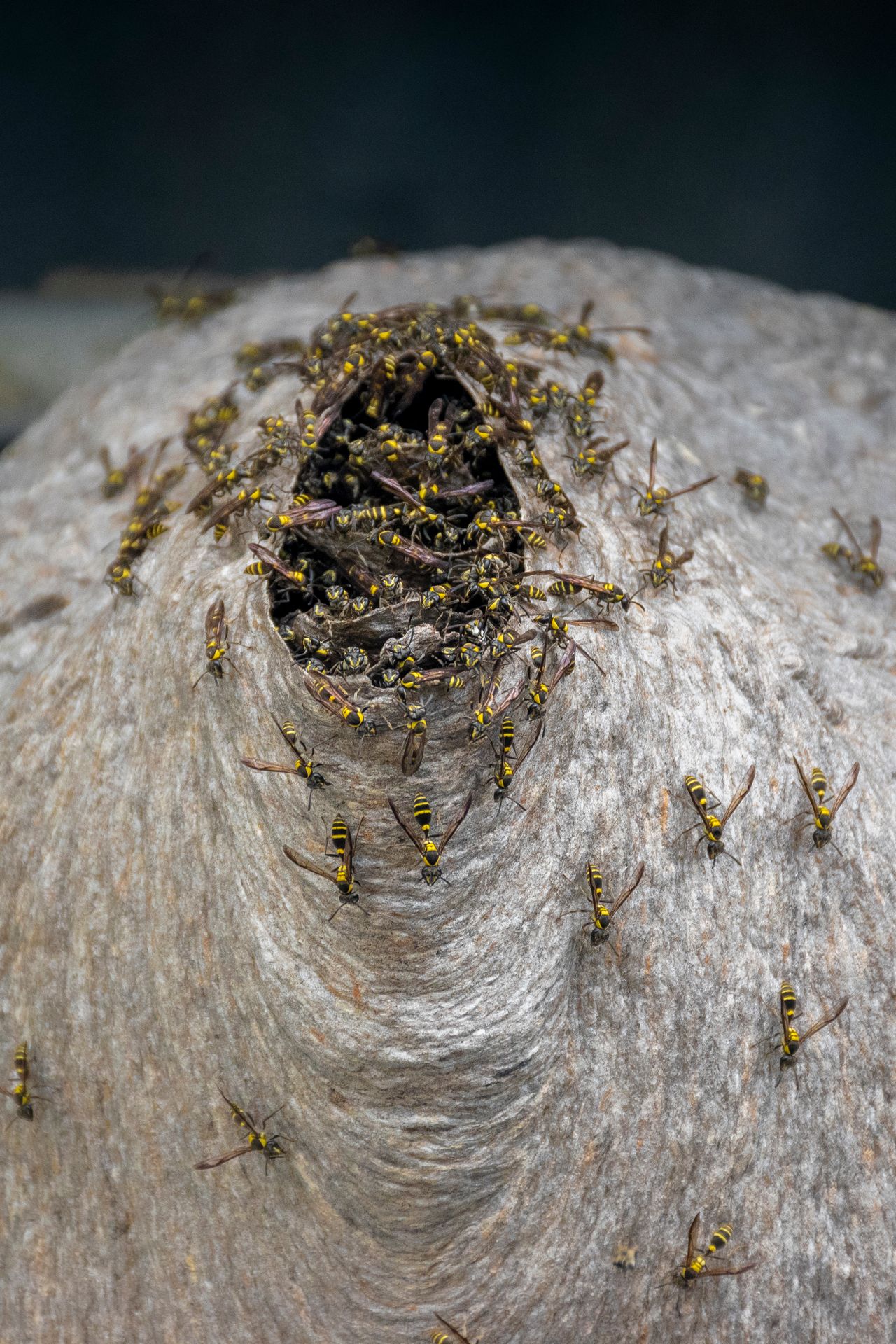
If your wasp nest was treated a couple of hours ago and you are stood in the garden watching wasps still fly in and out, nothing has gone wrong. You will keep seeing wasps for a day or two, sometimes a little longer, and that is exactly what a treatment that is working looks like. The wasps you can see are carrying the treatment into the nest for you. This page explains what the next few days actually look like, when to stop worrying, and the one thing not to do.
Why you can still see wasps flying in and out
When a technician treats a nest, an insecticidal dust is applied at the entrance and, where it can be reached, into the nest itself. At any moment during the day a large share of the colony is out foraging — away from the nest, hunting insects or scavenging. Those foragers are never touched by the treatment. They come home over the following hours, walk straight through the treated entrance, and carry the dust deep inside on their bodies. There it spreads as wasps groom one another and move across the combs, reaching the queen and the larvae that a surface spray would never touch.
That is the whole point. A product that dropped every visible wasp on the spot would leave the returning foragers and the protected interior untouched, and the colony would simply carry on. The slower kill is the thorough one. So the flight you are watching two hours later is not a failed treatment — it is the mechanism doing its job.
How long until the wasps actually die
The timeline depends on the time of year, and mostly on temperature. In warm weather the colony is busy and foragers cycle in and out quickly, so the treatment spreads fast. As the nights cool in autumn, everything slows down.
- July and August (peak season): activity usually drops sharply within a few hours and is close to finished within 24 to 48 hours. A busy nest can still look almost normal on the evening of the treatment and be silent by the next afternoon.
- September onwards (late season): slower. Cooler nights mean the wasps move less, forage less, and carry the treatment around the nest more gradually. A late-autumn nest can take several days, occasionally the best part of a week, to go fully quiet.
- Either way: activity tapers rather than stops dead. You will see a lot, then a few, then the odd one, then none.
When it is worth ringing back
The thing to watch is not whether you see any wasps, but whether the traffic is still a steady two-way commute after about a week. An occasional wasp drifting around the patio, or one or two dozy ones at the old entrance, is the tail end of a dying colony and needs nothing at all. A continuous stream in and out of the same hole, in both directions, seven days on, is the sign to call.
The £60 covers a free return and re-treatment if the first visit has not fully worked, and you only pay once the nest is confirmed destroyed. So if a nest is clearly still active a week later, phone and we will come back out — there is nothing more to pay.
Do not seal the hole yet
Do not block the entry point until all outside activity has completely stopped. It is tempting to fill the gap while the wasps are groggy, but sealing a nest that still has live workers inside forces them to find another way out — and the way out is often into the house, chewing through plasterboard, downlighter holes, or around the loft hatch to reach the light of a room. Wait until you have watched the entrance for a day or two with no coming and going, then seal it if you want to stop a future queen using the same gap. There is no rush; an empty entrance does no harm left open.
Does the nest itself need removing?
In most cases, no. The nest is just chewed-up paper — once the colony inside is dead it does nothing and breaks down slowly on its own. Where the nest is easy to reach, in a shed or on an exposed soffit, it can be knocked down once we are sure it is dead. A nest in a wall cavity, a loft void, or under the floor is usually best left exactly where it is: reaching it can mean lifting tiles or cutting into plasterboard, and there is no benefit, because wasps never reuse an old nest. An empty nest in a loft can sit there for years doing nothing.
Dead wasps, and what an old nest can attract
For a few days after treatment you will find dead wasps — on internal windowsills if the nest was in a wall or loft, on the ground beneath an outdoor nest, and in the loft itself. This is normal, and it stops. Sweep or hoover them up; they cannot sting once dead.
One honest note about leaving a large nest in a loft for the long term: the dead brood and paper can, occasionally, attract secondary scavengers such as carpet beetles and their larvae, or cluster flies looking for somewhere to shelter. This is uncommon and slow, not something that happens in the days after treatment, but it is the one real reason to take down an accessible old nest rather than leave it indefinitely. A nest sealed inside a cavity you cannot easily reach is not worth disturbing the ceiling over.
Pets, children, and the vegetable bed
The products used are the same class of insecticide used in professional pest control everywhere, applied in small amounts at the nest entrance — not sprayed around the garden. Once the dust has settled, after a few hours, the treated area is safe to walk past, and children and pets can use the garden as normal. Keep them away from the immediate entrance while wasps are still active and defensive, and discourage a dog from eating dead wasps in any quantity, which is sensible advice for dead insects generally rather than a treatment concern.
There is no need to lift your vegetables, wash down the patio, or keep off the lawn. The dust is at the nest, not on your salad. If a treated nest happens to sit directly above a vegetable bed, give the produce underneath a normal rinse before eating, as you would anyway.
Will they come back to the same nest next year?
No. Wasps never reuse an old nest. Everybody asks this in spring, so it is worth being plain: the colony you had this year dies out completely in autumn, and the paper nest is abandoned for good. Next year's queens — if any of last year's survived the winter — build somewhere entirely new. A nest in the same spot two years running means a fresh queen independently liked the same cavity, not that the old colony returned. That is also why there is no value in removing a dead nest to "stop them coming back": the nest was never the draw.
A week on and it's still busy?
If a treated nest is still a steady two-way stream of wasps about a week later, that is the point to ring us. The £60 covers a free return and re-treatment if the first visit has not fully worked, same-day where we can across Stockport and Greater Manchester. No obligation — a quick call to 07770 015197 and we will tell you honestly whether it needs a second visit.
Call to BookFrequently Asked Questions
Because that is normal, and it means the treatment is working. Wasps that were out foraging when the technician called return over the next day or two, walk through the treated entrance, and carry the insecticide into the nest, which is how the colony is killed. Expect activity to taper over 24 to 48 hours in warm weather.
Usually one to two days in the warm months of July and August, and longer from September onwards when cooler weather slows the colony down, sometimes the best part of a week. Activity fades gradually rather than stopping all at once.
Not in the first few days. Ongoing activity straight after treatment is expected. The only sign worth acting on is a steady, two-way stream of wasps still using the same hole about a week later. If that is what you are seeing, call us and we will return and re-treat at no extra charge.
Only once all activity at the entrance has completely stopped, which usually takes a few days. Sealing the hole while live wasps are still inside forces them to chew a new way out, often into the house. Watch the entrance until there is no movement, then seal it if you want to.
No. Once the colony is dead the nest is just harmless paper and does not need removing. An accessible nest in a shed or on a soffit can be taken down, but a nest inside a wall or loft is best left alone. Wasps never reuse it.
No. Wasps never reuse an old nest. The colony dies out completely in autumn and the nest is abandoned for good. If a nest appears in the same place the following year, it is a new queen that happened to like the same spot, not the old colony returning.
Yes, once the dust has settled after a few hours. The insecticide is applied at the nest entrance in small amounts, not across the garden, so the lawn, patio and vegetable beds are fine to use as normal. Keep pets from eating dead wasps in quantity as a general precaution, and rinse any produce growing directly under a treated nest before eating.